Mosaic Luxe 1 Seamless Digital Papers
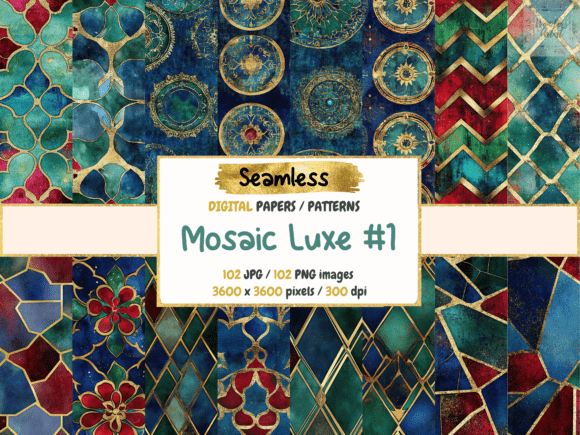
Hello, beautiful person. If you are looking to elevate your creative projects with a touch of opulence, you have likely encountered the Mosaic Luxe 1 Seamless Digital Papers. This bundle is designed for those who appreciate intricate artistry and shimmering elegance. However, simply downloading a high-resolution image is only half the battle. To truly harness the power of these geometric mosaic patterns, metallic gold accents, and vibrant jewel tones, you need to understand how to integrate them effectively into your workflow.
Many creators rush into using digital papers without considering resolution, color profiles, or design balance. This often leads to pixelated prints, muddy colors, or designs that feel cluttered rather than sophisticated. Let’s explore how to avoid these common pitfalls and make the most of this stunning collection for invitations, branding, decor, and more.
Understanding the Value of Seamless Patterns
The primary advantage of choosing seamless digital papers over standard static images is versatility. A seamless pattern can be tiled infinitely in any direction without visible breaks. This is crucial for background design in web development, packaging, wallpaper creation, and large-format printing. When you use Mosaic Luxe 1, you are not just getting a texture; you are acquiring a modular asset that adapts to various canvas sizes while maintaining its structural integrity.
However, beginners often mistake "high resolution" for "print-ready." It is essential to verify the DPI (dots per inch) before purchasing or downloading. For screen-based projects like blogs or social media graphics, 72 DPI is usually sufficient. But if you plan to print physical invitations or luxury business cards, you must ensure the files are at least 300 DPI. Using a low-resolution file for print will result in jagged edges and a loss of the delicate detail that makes the mosaic tiles look authentic.
Avoiding Color Profile Missteps
One of the most overlooked details when working with digital assets is color management. The Mosaic Luxe collection features rich, luminous textures and gilded metallics. These elements rely heavily on accurate color representation to convey their luxurious essence. Most digital papers are provided in the sRGB color space, which is ideal for web and screen display. If you attempt to use an sRGB file for professional offset printing without converting it to CMYK, you may notice that the vibrant jewel tones appear dull or shifted.
To prevent this, always check the intended output medium before applying the paper. If you are designing for Instagram or a website, keep the file in sRGB. If you are sending files to a professional printer, convert the colors to CMYK within your design software (such as Adobe Photoshop or Illustrator) before finalizing the layout. This simple step ensures that the gold foils and deep blues remain true to the artist’s vision, preventing costly reprints and disappointing results.
Balancing Opulence with Simplicity
When working with intricate geometric tilework, there is a natural tendency to over-design. The allure of the Mosaic Luxe patterns lies in their complexity, but adding too many competing elements can overwhelm the viewer. A common mistake is layering multiple busy patterns or placing heavy typography directly over detailed mosaic sections without adequate contrast.
Practical Advice: Use the digital paper as a supporting element rather than the sole focus. Allow the pattern to breathe by incorporating significant negative space. If you are creating an invitation, consider using the mosaic paper for the border or envelope liner, while keeping the central text area clean and solid-colored. This approach guides the eye to the important information while still showcasing the artistic beauty of the design.
Another effective strategy is to desaturate or overlay a semi-transparent solid color on top of the mosaic pattern. This technique, known as toning, can unify the design and make text more readable. For example, placing a white text box with a slight drop shadow over a dark, intricate mosaic background creates depth and legibility without sacrificing the luxurious aesthetic.
Technical Considerations for File Formats
The Mosaic Luxe 1 Seamless Digital Papers are available in JPG format, offering flexibility for various creative ideas. While JPG is convenient due to its small file size and universal compatibility, it is a lossy compression format. This means that every time you save the file, some data is lost, potentially introducing artifacts around the sharp edges of the geometric tiles.
If you are planning to edit the papers extensively—such as cropping, rotating, or applying filters—it is advisable to work with uncompressed formats if available, or to minimize the number of times you save the file. Additionally, be mindful of the aspect ratio. Ensure that the dimensions of the digital paper align with your project’s needs. Tiling a square pattern onto a rectangular canvas might require careful alignment to avoid awkward gaps at the seams.
Evaluating Quality Before You Commit
Before integrating these papers into commercial projects, take the time to evaluate the quality yourself. Zoom in to 100% or 200% to inspect the edges of the tiles and the smoothness of the gradients. Look for any unintended blurring or pixelation that might indicate poor upscaling. High-quality digital papers should maintain crisp lines even at higher magnifications.
Furthermore, consider the licensing terms. Even though these are digital products, usage rights vary. Some licenses allow for personal use only, while others permit commercial application in end-products like printed goods. Always read the fine print to ensure you are compliant, especially if you are selling items created with these papers. Violating licensing agreements can lead to legal issues and damage your reputation as a creator.
Maximizing Creativity with Strategic Application
Once you have avoided the technical and design traps, you can fully embrace the potential of Mosaic Luxe 1. Here are a few advanced ways to use these patterns:
- Branding Elements: Use subtle mosaic textures in the background of business cards or letterheads to add a tactile feel to digital documents.
- Digital Scrapbooking: Combine different variations from the collection to create unique page layouts that tell a story through texture.
- Event Decor: Create seamless backgrounds for virtual event backdrops or print large-scale banners where the pattern adds grandeur without requiring expensive physical materials.
- Fashion Design Mockups: Apply the patterns to clothing templates to visualize fabric designs for bohemian luxury collections.
In conclusion, the Mosaic Luxe 1 Seamless Digital Papers offer a sophisticated toolkit for elevating your designs. By paying attention to resolution, color profiles, compositional balance, and licensing, you can avoid common mistakes and produce work that truly reflects the opulent spirit of the collection. Take your time, experiment with layering, and let the intricate details shine. Your audience will appreciate the refinement and care put into every pixel.